Filters

Media:

Formats:

Roles:

Tools:

Context:

Bibliotheekpraat & Verbindend Werken

Cards , Booklet

Sharing, questioning and doing

Description

Developed with Creative Media for Social Change, Bibliotheekpraat and Verbindend Werken bij de Bibliotheek translate research on neighbourhood-oriented library work into two practical publishing tools for library workers.

How can research become something that people don’t simply read, but use to reflect, converse and work differently?

I developed a visual system around the relationship between the library worker, the neighbourhood and the library itself. This structure carries across a workbook for individual reflection and a card set designed to initiate conversations between colleagues and communities.

The workbook turns the research into twelve exercises that can be completed and revisited over time, while Bibliotheekpraat transforms related questions into a more open and social format, organized around sharing, questioning and doing. Together, the two publications allow the same research to move between individual reflection and collective conversation.

My role: Visual concept, publishing system, publication design, card-set design & production development Research & content: Creative Media for Social Change / project collaborators

Knowledge Landscape

Website , Wiki

Living Interfaces for Living Researches

Description

Knowledge-land-scape extends Saskia de Wildt’s PhD research on the ethical reconciliation of Inuit Qaujimajatuqangit and Western sciences within community-based polar bear research. Her research developed into a complex landscape of interconnected stories, encounters and insights, organized into pathways that readers could follow in different ways.

How can a complex and open-ended research structure become a digital publication without fixing it into a single narrative?

Working in collaboration with Saskia, I translated this research structure into a visual and technical publishing system. We chose MediaWiki as its underlying infrastructure, allowing the material to remain editable and continue evolving. I designed and developed a custom interface on top of the wiki, giving Saskia a way to build and connect her own stories while allowing readers to navigate the resulting landscape through different paths.

The system was also shaped by the conditions in which the research might be accessed. Images were kept below 1MB to reduce bandwidth requirements and the project’s digital footprint, making the publication more accessible in northern communities where internet connections can be limited. The project was conceived with a five-year online lifespan and the possibility of eventually translating the evolving website into a physical publication through a web-to-print process.

The result is a living digital publication in which the infrastructure supports the open-ended character of the research, rather than resolving it into a fixed account.

My roles:

  • Publishing system
  • web design & development

Research & content:

  • Saskia de Wildt

The Doubt Times

Placemat

The Paper that Prints the Doubts

Description

The Doubt Times

The Doubt Times is a publication developed with Creative Media for Social Change as part of Desinformatie in Kaart, a research project exploring misinformation and media literacy within the Amsterdam University of Applied Sciences. The research approached media as an ecology: a landscape in which we move, make choices, encounter polluted areas, and influence through our own participation.

How could this research be translated into an output that encourages doubt and reflection, beyond simply telling people what is true or false?

I created a publication that translated research insights around care, responsibility, reciprocity and not-knowing into questions, visual metaphors and memes. It doesn’t explain the research, it uses simple gestures and interruptions to invite readers to question their own position within the information landscape.

The final outcome takes the form of four newspaper variations designed to circulate throughout the university. Headlines become questions, while dense and partially illegible texts evoke informational overload. Illustrations and visual interventions create moments of ambiguity, using doubt not as uncertainty to resolve, but as a way to pause, reflect and look differently at the information we consume.

The Doubt Times was produced in an edition of 800 copies.

Details:

  • 2 inks offset printing
  • 4 versions/ 200 copies each
  • Recycled paper
  • Printed by Raddraaier SSP

We De Try

Book

How Could We Listen?

Description

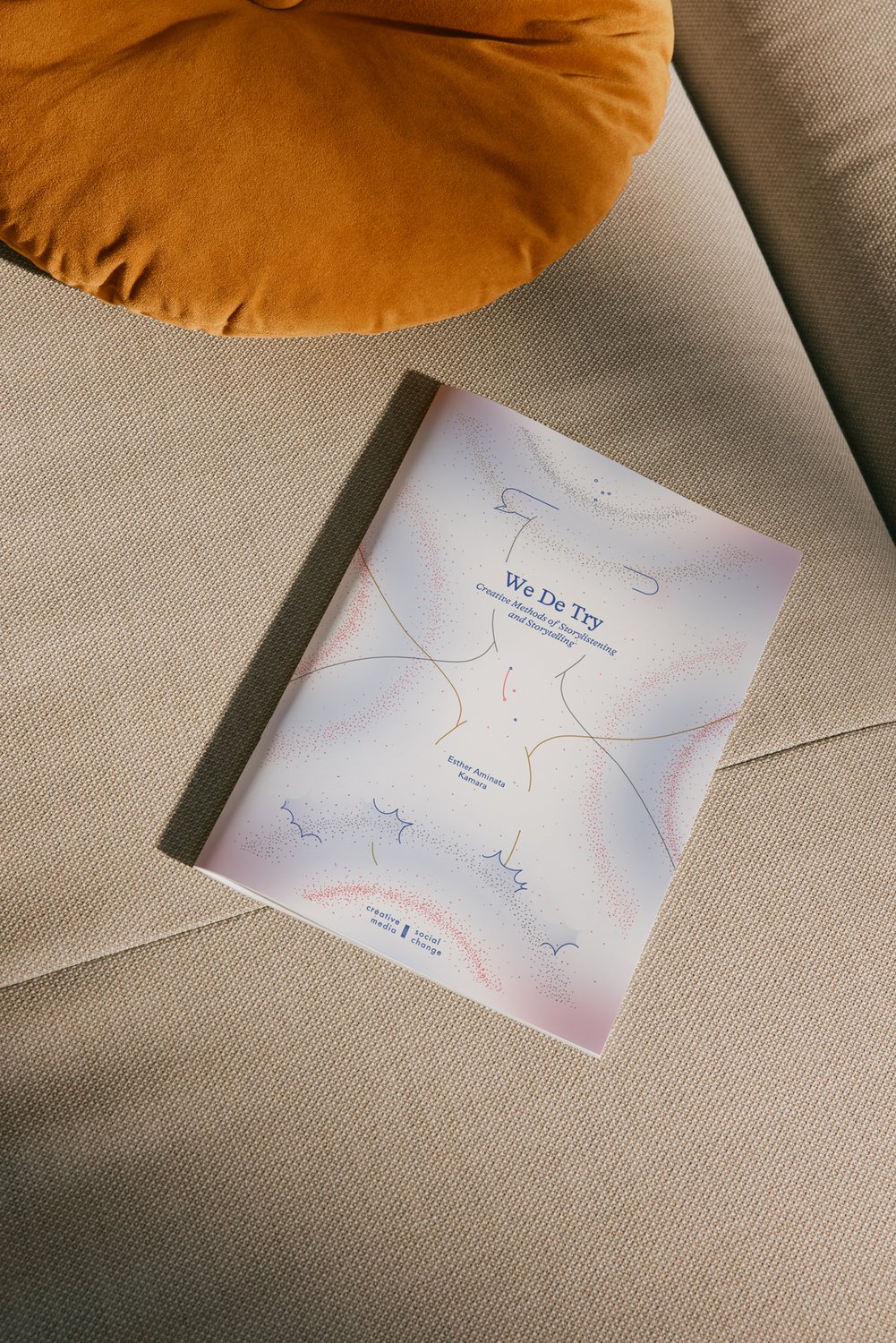
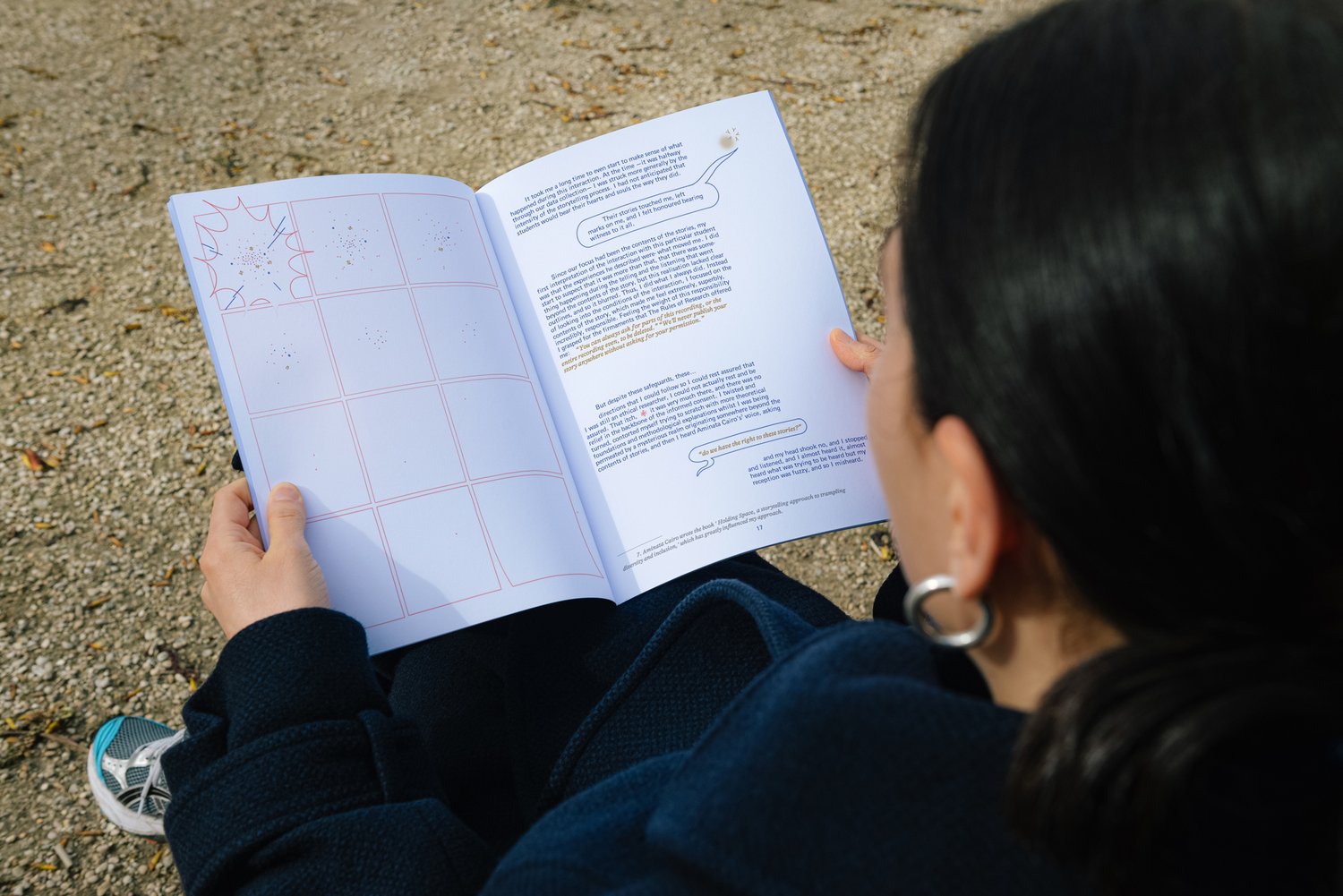
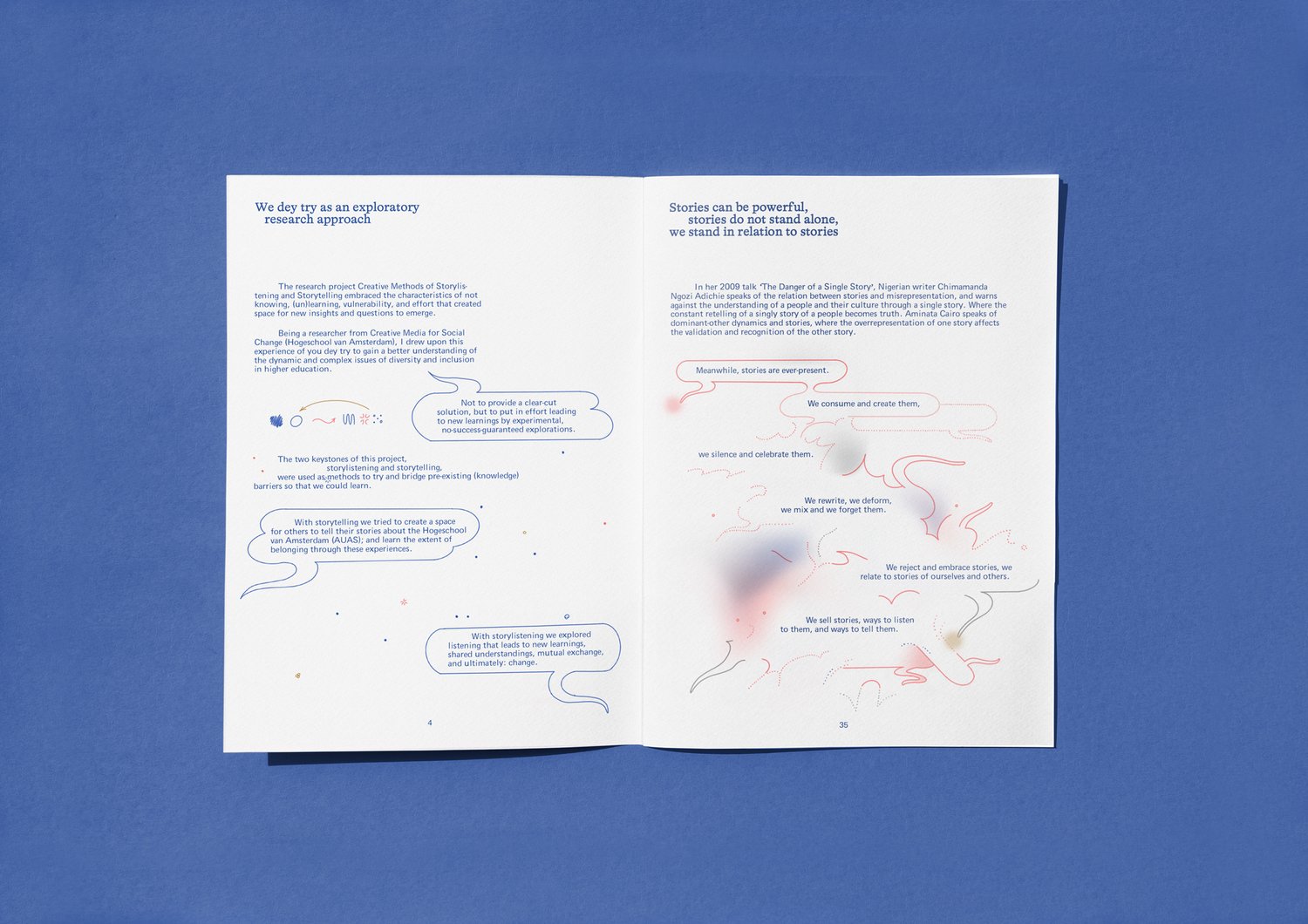
We De Try is a publication developed with Esther Aminata Kamara and Creative Media for Social Change, exploring storytelling and story-listening as research practices within higher education. The research follows a process of questioning how stories are listened to, interpreted and shared, and what care and responsibility mean within these encounters.

How can a publication give form to a personal and non-linear research journey while inviting the reader to listen along the way?

Working with Esther, I first explored different forms the research could take, including an interactive website, a podcast series and an illustrated book. Together we chose to develop the book, and I translated her writing and research journey into a visual and material form.

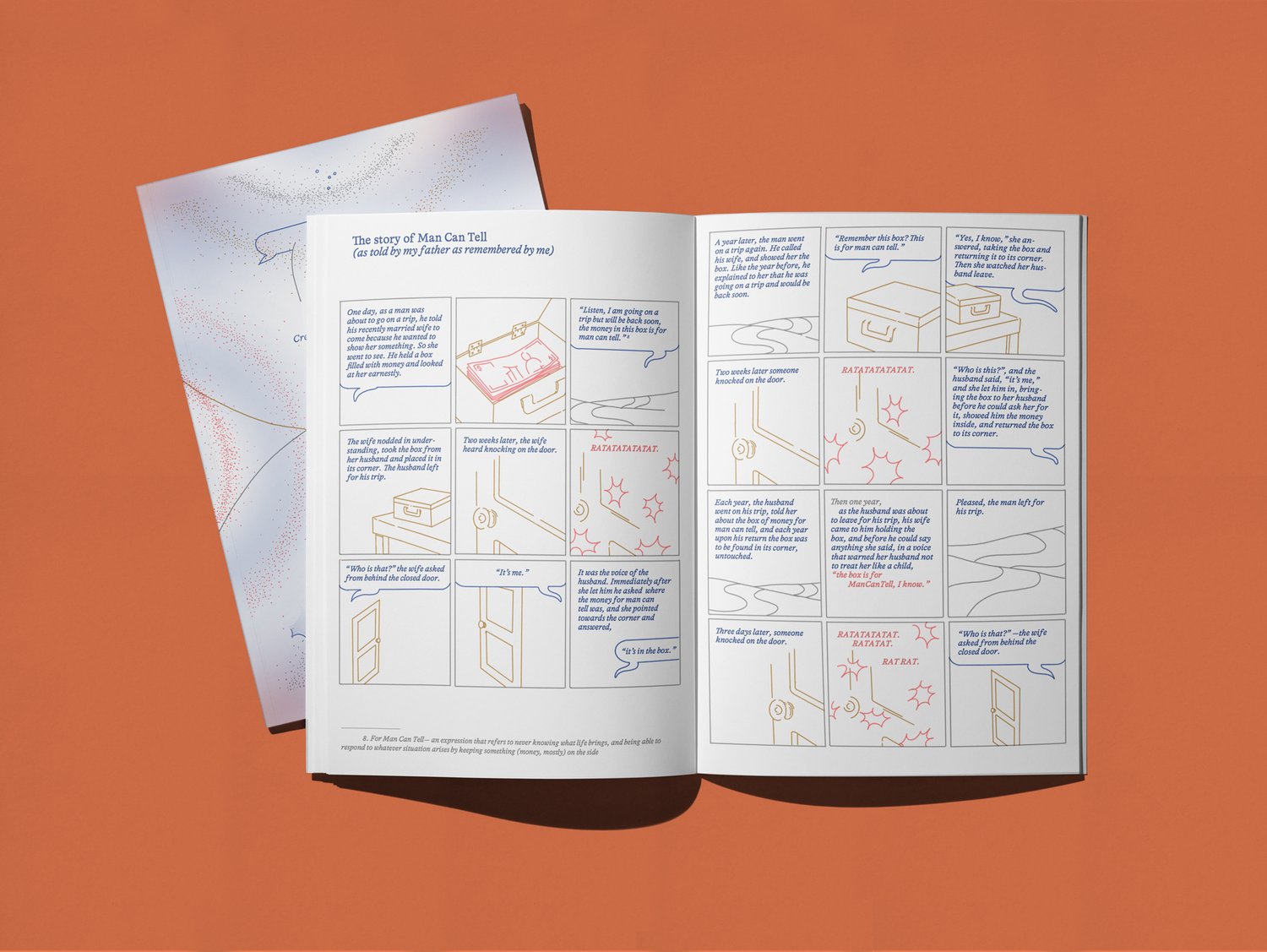
I designed and illustrated the publication as a continuous reading experience, using drawings, diagrams, shifts in composition and speech-like elements to accompany the movement between personal stories, research reflections and theoretical ideas. The visual language moves alongside the writing and helps give rhythm and form to the changes in voice and perspective.

The final publication was printed and binded by me in 4 color RISO printing, carrying the project from early publishing exploration through design, illustration and final production.

My role:

  • Publishing concept
  • Format exploration
  • Illustration
  • Publication design
  • RISO printing & production

Research & writing:

  • Esther Aminata Kamara

Editorial collaboration:

  • Tamara Witschge

Details:

  • 32p
  • 50 copies.
  • Paper: Natural Arena 120g & 240g
  • RISO print 4 inks

Images:

  • We De Try RISO-printed book cover
  • We De Try RISO-printed book interior spread
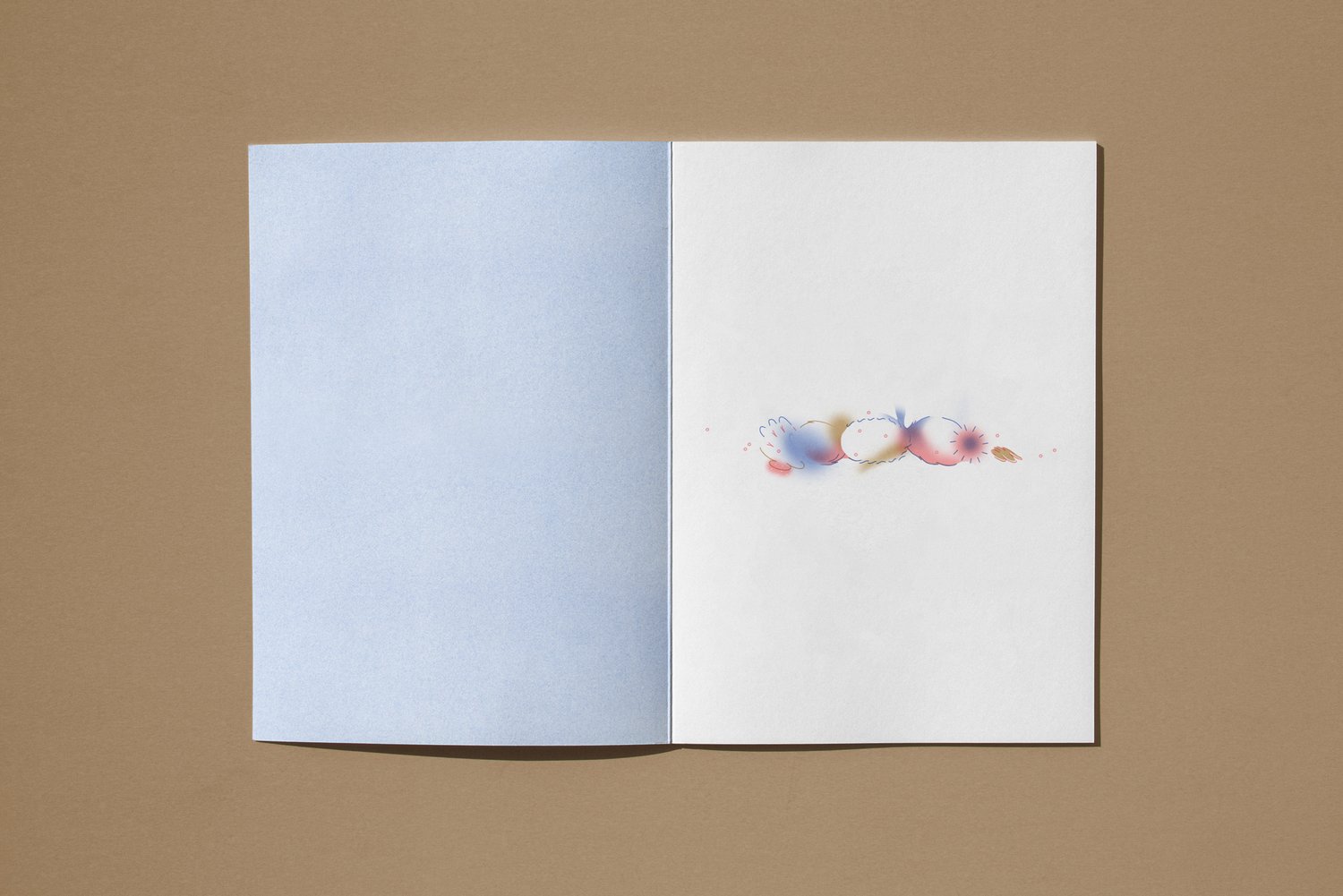
  • We De Try RISO-printed book opening spread
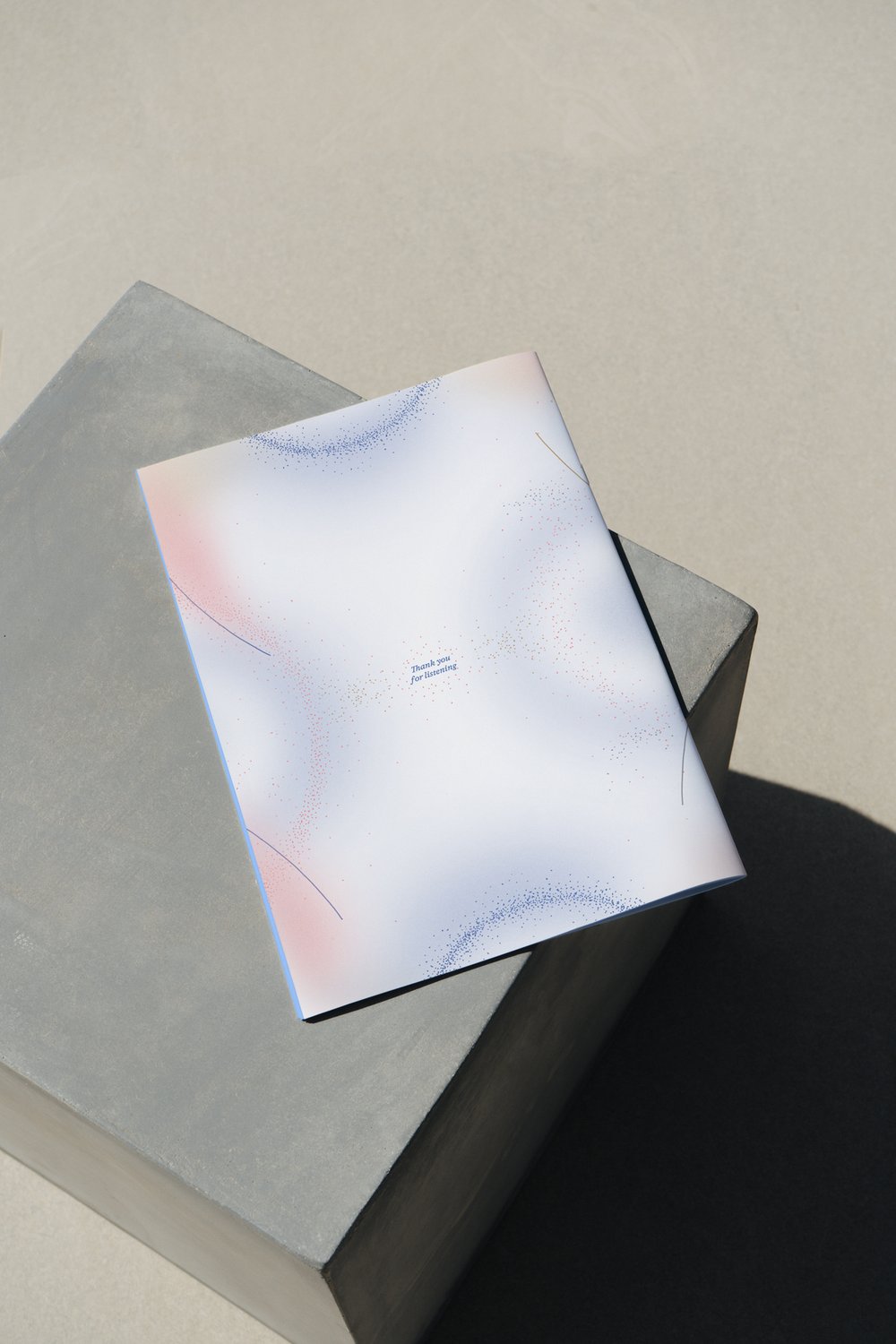
  • We De Try RISO-printed book cover on a table
  • We De Try RISO-printed book read by a person
  • We De Try RISO-printed book interior spread on blue paper

Digesting Care

Website , Zine , Illustration

Digesting Care Publication

Description

Digesting Care is an experimental publication developed with Kendal Beynon for TAKING CARE, a European research project exploring care and kinship within ethnographic and world cultures museums.

How can a publication make connections across a conference without reducing its complex and sometimes unresolved conversations into a single narrative?

We attended the conference as listeners and participants, using drawing as a form of note-taking to capture ideas, conversations and relationships beyond written documentation. Recurring concepts such as contradiction, plurality, fabulation, entanglement and the unknown became a tagging system through which papers, presentations, photographs and workshop materials could be connected.

Rather than separating editorial work, design and development, we built a publishing infrastructure in which these processes could inform each other. Collaborative text files and tags were transformed through Python into a lightweight website, while the same content and visual system extended into a physical publication. The digital version uses semantic HTML and dithered images, with high-resolution media available on demand, considering accessibility, resilience and energy use as part of the publishing process.

The website also became the blue print for the physical edition. Fifty different states of the website were printed, producing 50 unique versions of the publication. Rather than reproducing a single definitive arrangement, each copy preserves one possible reading of the material.

The result is a hybrid publication that treats publishing not as the documentation of a finished conversation, but as a way of revealing relationships between ideas and allowing different readings to emerge across digital and physical forms.

My role:

  • Illustration
  • Publication design
  • Web design & development

Editorial collaboration:

  • Kendal Beynon

Bibliotheekpraat & Verbindend Werken

Cards , Booklet

Description

Developed with Creative Media for Social Change, Bibliotheekpraat and Verbindend Werken bij de Bibliotheek translate research on neighbourhood-oriented library work into two practical publishing tools for library workers.

How can research become something that people don’t simply read, but use to reflect, converse and work differently?

I developed a visual system around the relationship between the library worker, the neighbourhood and the library itself. This structure carries across a workbook for individual reflection and a card set designed to initiate conversations between colleagues and communities.

The workbook turns the research into twelve exercises that can be completed and revisited over time, while Bibliotheekpraat transforms related questions into a more open and social format, organized around sharing, questioning and doing. Together, the two publications allow the same research to move between individual reflection and collective conversation.

My role: Visual concept, publishing system, publication design, card-set design & production development Research & content: Creative Media for Social Change / project collaborators

Knowledge Landscape

Website , Wiki

Description

Knowledge-land-scape extends Saskia de Wildt’s PhD research on the ethical reconciliation of Inuit Qaujimajatuqangit and Western sciences within community-based polar bear research. Her research developed into a complex landscape of interconnected stories, encounters and insights, organized into pathways that readers could follow in different ways.

How can a complex and open-ended research structure become a digital publication without fixing it into a single narrative?

Working in collaboration with Saskia, I translated this research structure into a visual and technical publishing system. We chose MediaWiki as its underlying infrastructure, allowing the material to remain editable and continue evolving. I designed and developed a custom interface on top of the wiki, giving Saskia a way to build and connect her own stories while allowing readers to navigate the resulting landscape through different paths.

The system was also shaped by the conditions in which the research might be accessed. Images were kept below 1MB to reduce bandwidth requirements and the project’s digital footprint, making the publication more accessible in northern communities where internet connections can be limited. The project was conceived with a five-year online lifespan and the possibility of eventually translating the evolving website into a physical publication through a web-to-print process.

The result is a living digital publication in which the infrastructure supports the open-ended character of the research, rather than resolving it into a fixed account.

My roles:

  • Publishing system
  • web design & development

Research & content:

  • Saskia de Wildt

The Doubt Times

Placemat

Description

The Doubt Times

The Doubt Times is a publication developed with Creative Media for Social Change as part of Desinformatie in Kaart, a research project exploring misinformation and media literacy within the Amsterdam University of Applied Sciences. The research approached media as an ecology: a landscape in which we move, make choices, encounter polluted areas, and influence through our own participation.

How could this research be translated into an output that encourages doubt and reflection, beyond simply telling people what is true or false?

I created a publication that translated research insights around care, responsibility, reciprocity and not-knowing into questions, visual metaphors and memes. It doesn’t explain the research, it uses simple gestures and interruptions to invite readers to question their own position within the information landscape.

The final outcome takes the form of four newspaper variations designed to circulate throughout the university. Headlines become questions, while dense and partially illegible texts evoke informational overload. Illustrations and visual interventions create moments of ambiguity, using doubt not as uncertainty to resolve, but as a way to pause, reflect and look differently at the information we consume.

The Doubt Times was produced in an edition of 800 copies.

Details:

  • 2 inks offset printing
  • 4 versions/ 200 copies each
  • Recycled paper
  • Printed by Raddraaier SSP

We De Try

Book

Description

We De Try is a publication developed with Esther Aminata Kamara and Creative Media for Social Change, exploring storytelling and story-listening as research practices within higher education. The research follows a process of questioning how stories are listened to, interpreted and shared, and what care and responsibility mean within these encounters.

How can a publication give form to a personal and non-linear research journey while inviting the reader to listen along the way?

Working with Esther, I first explored different forms the research could take, including an interactive website, a podcast series and an illustrated book. Together we chose to develop the book, and I translated her writing and research journey into a visual and material form.

I designed and illustrated the publication as a continuous reading experience, using drawings, diagrams, shifts in composition and speech-like elements to accompany the movement between personal stories, research reflections and theoretical ideas. The visual language moves alongside the writing and helps give rhythm and form to the changes in voice and perspective.

The final publication was printed and binded by me in 4 color RISO printing, carrying the project from early publishing exploration through design, illustration and final production.

My role:

  • Publishing concept
  • Format exploration
  • Illustration
  • Publication design
  • RISO printing & production

Research & writing:

  • Esther Aminata Kamara

Editorial collaboration:

  • Tamara Witschge

Details:

  • 32p
  • 50 copies.
  • Paper: Natural Arena 120g & 240g
  • RISO print 4 inks

Images:

  • We De Try RISO-printed book cover
  • We De Try RISO-printed book interior spread
  • We De Try RISO-printed book opening spread
  • We De Try RISO-printed book cover on a table
  • We De Try RISO-printed book read by a person
  • We De Try RISO-printed book interior spread on blue paper

Digesting Care

Website , Zine , Illustration

Description

Digesting Care is an experimental publication developed with Kendal Beynon for TAKING CARE, a European research project exploring care and kinship within ethnographic and world cultures museums.

How can a publication make connections across a conference without reducing its complex and sometimes unresolved conversations into a single narrative?

We attended the conference as listeners and participants, using drawing as a form of note-taking to capture ideas, conversations and relationships beyond written documentation. Recurring concepts such as contradiction, plurality, fabulation, entanglement and the unknown became a tagging system through which papers, presentations, photographs and workshop materials could be connected.

Rather than separating editorial work, design and development, we built a publishing infrastructure in which these processes could inform each other. Collaborative text files and tags were transformed through Python into a lightweight website, while the same content and visual system extended into a physical publication. The digital version uses semantic HTML and dithered images, with high-resolution media available on demand, considering accessibility, resilience and energy use as part of the publishing process.

The website also became the blue print for the physical edition. Fifty different states of the website were printed, producing 50 unique versions of the publication. Rather than reproducing a single definitive arrangement, each copy preserves one possible reading of the material.

The result is a hybrid publication that treats publishing not as the documentation of a finished conversation, but as a way of revealing relationships between ideas and allowing different readings to emerge across digital and physical forms.

My role:

  • Illustration
  • Publication design
  • Web design & development

Editorial collaboration:

  • Kendal Beynon

Description

Developed with Creative Media for Social Change, Bibliotheekpraat and Verbindend Werken bij de Bibliotheek translate research on neighbourhood-oriented library work into two practical publishing tools for library workers.

How can research become something that people don’t simply read, but use to reflect, converse and work differently?

I developed a visual system around the relationship between the library worker, the neighbourhood and the library itself. This structure carries across a workbook for individual reflection and a card set designed to initiate conversations between colleagues and communities.

The workbook turns the research into twelve exercises that can be completed and revisited over time, while Bibliotheekpraat transforms related questions into a more open and social format, organized around sharing, questioning and doing. Together, the two publications allow the same research to move between individual reflection and collective conversation.

My role: Visual concept, publishing system, publication design, card-set design & production development Research & content: Creative Media for Social Change / project collaborators

Sharing, questioning and doing

Cards , Booklet

Description

Knowledge-land-scape extends Saskia de Wildt’s PhD research on the ethical reconciliation of Inuit Qaujimajatuqangit and Western sciences within community-based polar bear research. Her research developed into a complex landscape of interconnected stories, encounters and insights, organized into pathways that readers could follow in different ways.

How can a complex and open-ended research structure become a digital publication without fixing it into a single narrative?

Working in collaboration with Saskia, I translated this research structure into a visual and technical publishing system. We chose MediaWiki as its underlying infrastructure, allowing the material to remain editable and continue evolving. I designed and developed a custom interface on top of the wiki, giving Saskia a way to build and connect her own stories while allowing readers to navigate the resulting landscape through different paths.

The system was also shaped by the conditions in which the research might be accessed. Images were kept below 1MB to reduce bandwidth requirements and the project’s digital footprint, making the publication more accessible in northern communities where internet connections can be limited. The project was conceived with a five-year online lifespan and the possibility of eventually translating the evolving website into a physical publication through a web-to-print process.

The result is a living digital publication in which the infrastructure supports the open-ended character of the research, rather than resolving it into a fixed account.

My roles:

  • Publishing system
  • web design & development

Research & content:

  • Saskia de Wildt
Living Interfaces for Living Researches

Website , Wiki

Description

The Doubt Times

The Doubt Times is a publication developed with Creative Media for Social Change as part of Desinformatie in Kaart, a research project exploring misinformation and media literacy within the Amsterdam University of Applied Sciences. The research approached media as an ecology: a landscape in which we move, make choices, encounter polluted areas, and influence through our own participation.

How could this research be translated into an output that encourages doubt and reflection, beyond simply telling people what is true or false?

I created a publication that translated research insights around care, responsibility, reciprocity and not-knowing into questions, visual metaphors and memes. It doesn’t explain the research, it uses simple gestures and interruptions to invite readers to question their own position within the information landscape.

The final outcome takes the form of four newspaper variations designed to circulate throughout the university. Headlines become questions, while dense and partially illegible texts evoke informational overload. Illustrations and visual interventions create moments of ambiguity, using doubt not as uncertainty to resolve, but as a way to pause, reflect and look differently at the information we consume.

The Doubt Times was produced in an edition of 800 copies.

Details:

  • 2 inks offset printing
  • 4 versions/ 200 copies each
  • Recycled paper
  • Printed by Raddraaier SSP
The Paper that Prints the Doubts

Placemat

Description

We De Try is a publication developed with Esther Aminata Kamara and Creative Media for Social Change, exploring storytelling and story-listening as research practices within higher education. The research follows a process of questioning how stories are listened to, interpreted and shared, and what care and responsibility mean within these encounters.

How can a publication give form to a personal and non-linear research journey while inviting the reader to listen along the way?

Working with Esther, I first explored different forms the research could take, including an interactive website, a podcast series and an illustrated book. Together we chose to develop the book, and I translated her writing and research journey into a visual and material form.

I designed and illustrated the publication as a continuous reading experience, using drawings, diagrams, shifts in composition and speech-like elements to accompany the movement between personal stories, research reflections and theoretical ideas. The visual language moves alongside the writing and helps give rhythm and form to the changes in voice and perspective.

The final publication was printed and binded by me in 4 color RISO printing, carrying the project from early publishing exploration through design, illustration and final production.

My role:

  • Publishing concept
  • Format exploration
  • Illustration
  • Publication design
  • RISO printing & production

Research & writing:

  • Esther Aminata Kamara

Editorial collaboration:

  • Tamara Witschge

Details:

  • 32p
  • 50 copies.
  • Paper: Natural Arena 120g & 240g
  • RISO print 4 inks

Images:

  • We De Try RISO-printed book cover
  • We De Try RISO-printed book interior spread
  • We De Try RISO-printed book opening spread
  • We De Try RISO-printed book cover on a table
  • We De Try RISO-printed book read by a person
  • We De Try RISO-printed book interior spread on blue paper
How Could We Listen?

Book

Description

Digesting Care is an experimental publication developed with Kendal Beynon for TAKING CARE, a European research project exploring care and kinship within ethnographic and world cultures museums.

How can a publication make connections across a conference without reducing its complex and sometimes unresolved conversations into a single narrative?

We attended the conference as listeners and participants, using drawing as a form of note-taking to capture ideas, conversations and relationships beyond written documentation. Recurring concepts such as contradiction, plurality, fabulation, entanglement and the unknown became a tagging system through which papers, presentations, photographs and workshop materials could be connected.

Rather than separating editorial work, design and development, we built a publishing infrastructure in which these processes could inform each other. Collaborative text files and tags were transformed through Python into a lightweight website, while the same content and visual system extended into a physical publication. The digital version uses semantic HTML and dithered images, with high-resolution media available on demand, considering accessibility, resilience and energy use as part of the publishing process.

The website also became the blue print for the physical edition. Fifty different states of the website were printed, producing 50 unique versions of the publication. Rather than reproducing a single definitive arrangement, each copy preserves one possible reading of the material.

The result is a hybrid publication that treats publishing not as the documentation of a finished conversation, but as a way of revealing relationships between ideas and allowing different readings to emerge across digital and physical forms.

My role:

  • Illustration
  • Publication design
  • Web design & development

Editorial collaboration:

  • Kendal Beynon
Digesting Care Publication

Website , Zine , Illustration

Working together Reach out ↗

  1. What type of services do you offer?
  • Book design
  • Website design
  • Website development
  • PDF’s design
  • Digital publication
  • Editorial design
  • Print production
  1. How long do projects usually take?

Focused engagements 2–4 weeks

For urgent visual and editorial solutions, specific communication challenges, or focused experimentation.

Extended collaborations 1–3+ months

For developing and production of publications and communication assets both printed and digital.

  1. What are your typical fees?

Most of the publishing projects start around €5,000. However long extended collaborations can exceed this. Each collaboration is shaped around your needs and the complexity of the work.